
Sunday, January 27, 2013
le Beauce Festival
LE 4 IÈME FESTIVAL DE LA PIVOINE AURAS LIEU DANS LA BEAUCE LE 22 et 23 JUIN
 Submitted: M Mooijekind

Monday, January 14, 2013
ROSEMÈRE

LE 14 15 et 16 JUIN le comité est déja pret
martinus mooijekind responsable pour le QUÉBEC
LE 22 et 23 sera au tour du FESTIVAL DE LA PIVOINE DE LABEAUCE (PIVOINE EN CAVALE) sous la responsabilité de CLAUDE QUIRION
submitted by: M Mooijekind
Monday, December 31, 2012
Combination Peonies
 Combination
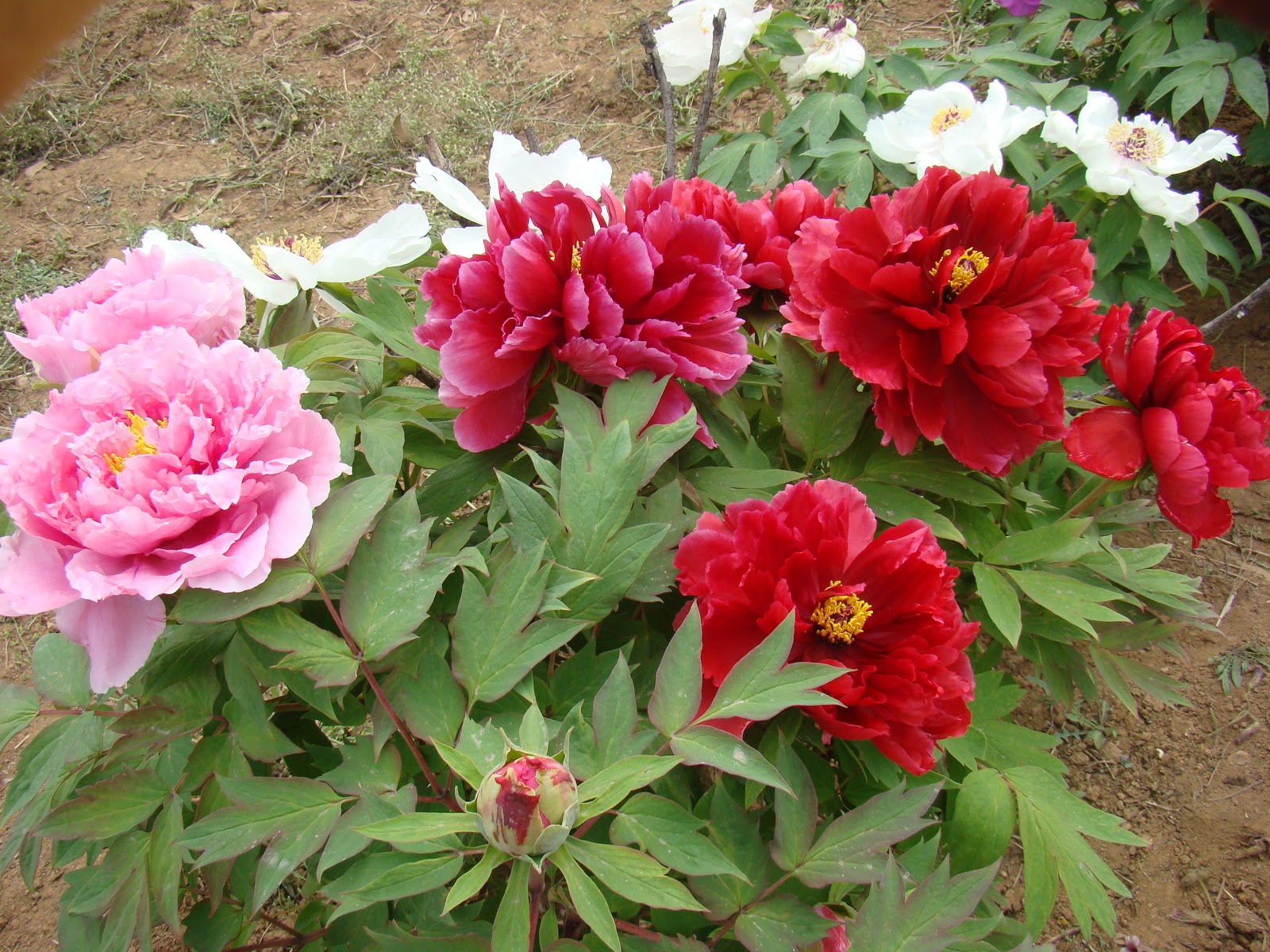
peonies are being cultivated by a Nursery in Gansu Province, Northwest
China. The pictures are a combination of Japanese and Chinese tree
peonies. This nursery has been experimenting with the crosses and found
them to be very successful. They are currently trying to cultivate
crosses between Japanese and Rockii tree peonies.
Combination
peonies are being cultivated by a Nursery in Gansu Province, Northwest
China. The pictures are a combination of Japanese and Chinese tree
peonies. This nursery has been experimenting with the crosses and found
them to be very successful. They are currently trying to cultivate
crosses between Japanese and Rockii tree peonies. 
The only one available for some time,"Rock's Peony". Original seed (supplied by Joseph Rock) grown stock was propagated and sent to botanical gardens.


 |
| Joseph Rock, Botanist Born 1884 Died 1962 |
 |
| Rocks Peony |
Rock's peony or Rock's tree peony (Paeonia rockii, also Paeonia suffruticosa subsp. rockii) is a woody species peony that was named after Joseph Rock. It is one of several species given the vernacular name tree peony, and is native to the mountains of midwestern China, mainly in Gansu and adjoining provinces. In Chinese, it is known as 牡丹 (mǔ dān) or 牡丹皮 (mǔ dān pí), and its flower is called 牡丹花 (mǔ dān huā). It became the unofficial national flower of China following a nationwide referendum in 1994.
Keep reading for future updates.
submitted by: M Sequeira
info taken from Wikipedia and sent by Nursery in Gansu Province
Saturday, December 22, 2012


Sunday, December 16, 2012
Portes ouvertes à St-Stanislas de Kostka

soumis par: Martinus Mooijekind
Saturday, December 15, 2012
Current Bloom Date Project, Part II
By Michael Denny
In the last CPS Newsletter, an article
described the history of the Bloom Date Project and the method used to
collect data. In this issue, I will discuss recent developments and the interpretation
of the bloom date evidence.
The project has a web site ( http://peonybloomdate.com ) that
contains several articles about the project and the data. There are two data
files that contain 11,000 observations on approximately 1100 cultivars. These
files contain the same evidence. However, the difference lies in that one file
sorts by the cultivar name, while the other sorts by the bloom offset. For each
cultivar, there are columns showing the description, the observations and the
offset. The description shows the colour but this is very elemental at the moment
and so almost the only colours cited are red, white and pink. (Better cultivar
descriptions are found in other sources.)
The crucial data in this project are the
observations and the offset. The observations indicate how many inspections
have been collected on the cultivar’s bloom date. This data is an indication of
the reliability of the evidence. The offset measures how many days the cultivar
first blooms before or after the peony Red Charm. The offset data for any
cultivar varies and I report the average offset. If there are only a few
observations, the average offset may be unreliable. As more observations are
collected, the average offset may change considerably. Currently there are five or more observations
on over 600 cultivars. This is
encouraging; but it indicates that for about 500 cultivars, there are only four
or fewer observations.
One of the reasons to continue to collect data
is to increase the number of observations on those cultivars, which currently
have relatively few observations. At the moment, I still have another 1100
observations on 500 cultivars that have not been included in the web site data.
These should be added this coming winter and hopefully will push some
additional cultivars beyond the five observations threshold. Please note that you should not assume that
the information on cultivars, which have only a few observations, is wrong. The
information may be correct. However, it
is a safer indication when there have been many observations.
How to Use the Data
Individuals
should use the offset evidence with some caution. Here is how I think about
this data. Suppose I am considering
three cultivars, peony A, peony B and peony C. The offsets are 7, 9 and 2 for
peony A, peony B and peony C respectively. The offsets for cultivars A and B
are close. So, I would consider them to bloom in my garden at the same time. It
may even be that A will bloom after B in some years. However, they should bloom
at about the same time.
Cultivar C has a lower offset and the difference
is large enough that I would assume C would bloom before the other two
cultivars. It may not bloom precisely five days before the others in my garden
but it should bloom earlier.
The
basic lesson is that the detailed data can be misleading; but when used with
caution, it can be very helpful. One can easily choose cultivars that will
bloom early in their garden as well as those which will bloom very late.
To my
way of thinking, the data provides a ranked list of blooming for peony
cultivars. At any given location and in different years the time between the
blooms for any given pair of cultivars can vary. If the weather is very warm,
the time shortens; if it is mild, the time expands.
Limitations
There are definite limitations to the data in
our project. First, we are dependent on many volunteers to observe and report
data. As a result, the following problems may arise: the identification of the
cultivar may be wrong; local soil, rain and the number of hours of sunshine can
alter the information. These I cannot control.
The major limitation arises from temperature variations both between
sites and across years.
At any site, the calendar dates on which a
cultivar blooms and the time between blooming for different cultivars is
altered by temperature patterns. The use of offsets from Red Charm represents an
attempt to address this. The offset adjustment is very useful; but it is far
too simple to completely adjust for temperature variations across sites and
across the years, even at the same site.
There is no simple alternative to our adjustment. In my judgement, the
project provides us with a large volume of useful information but we just need
to be careful in its use.
Future
In recent years, there have been
discussions about the creation of a new system of bloom information based on
weeks. This would build on the detailed project information but create six
categories that would cover all the cultivars. These efforts will be put
forward in a final article in the next issue.
Monday, November 5, 2012
Peony Growing on the Rock
By Erin Cullen
 Heritage peonies in Newfoundland
are distinct for a few reasons – 1) they bloom earlier than other peonies Newfoundland.
Yes, “early” means late June/early July. My other peonies are usually mid-July bloomers;
however, even in three years of living here I can see that this can vary
widely. Part of the reason for the variation is due to our climate in St. John’s.
I think the best quote I have heard about the St. John’s climate is that “there
is no ‘usual’ weather”. Being on the coast, we have what is referred to as a ‘hyperoceanic’
climate, which means we are affected by the ocean currents but also by mainland
North America. On many occasions I have seen weather go from sunny and 26 C one
day to rain, drizzle and fog and 11 C the next day. We could have two straight
weeks of fog and rain – in the middle of June. Spring can bring wild
temperature swings and precipitation. Instead of a gradual warming leading up
to summer, it in
Heritage peonies in Newfoundland
are distinct for a few reasons – 1) they bloom earlier than other peonies Newfoundland.
Yes, “early” means late June/early July. My other peonies are usually mid-July bloomers;
however, even in three years of living here I can see that this can vary
widely. Part of the reason for the variation is due to our climate in St. John’s.
I think the best quote I have heard about the St. John’s climate is that “there
is no ‘usual’ weather”. Being on the coast, we have what is referred to as a ‘hyperoceanic’
climate, which means we are affected by the ocean currents but also by mainland
North America. On many occasions I have seen weather go from sunny and 26 C one
day to rain, drizzle and fog and 11 C the next day. We could have two straight
weeks of fog and rain – in the middle of June. Spring can bring wild
temperature swings and precipitation. Instead of a gradual warming leading up
to summer, it in
Greetings
from St. John’s, Newfoundland! Before you delve into this article, I feel that
I just make a confession: although I am indeed a proud member of the Canadian
Peony Society, I am a relatively new member and I consider myself to be a “Gardener
in Training”. I became involved with the CPS through my mother who is an avid peony
grower. By “avid” I mean she has a garden with well over 100 varieties of
peonies that include every shape, size and colour and even includes some tree
peonies. Needless to say that as a new peony
grower it’s a lot to live up to! I love gardening and growing beautiful
peonies, but to date I must admit that I’m still learning.
My peony story dates
back three years ago when I left Ontario and moved into a home of my own for the
first time. Leaving the sunny skies of Southern Ontario, I drove for three
grueling days and one ferry ride to arrive on this beautiful, foggy rock that
we call Newfoundland. With my new home I inherited a few small gardens that
were definitely in need of a little bit of tender loving garden care. The first
spring in my new home, I immediately recognized those little red pointy shoots
starting to pop out of the ground – a peony! ‘Mom will be so excited’ was my
first thought. But as May passed and June was coming to a close, I thought for sure
there was something wrong with my peony. It was only starting to form those
perfect, globular buds. Knowing that peony season was in full force back home,
I thought I had a failure. But patience is required for gardening, and by late
in June I did have my peony open up and flower a gorgeous, rich magenta double
bloom. How beautiful! My euphoria was
short-lived: it was right after the first
bloom that we had a bit of rain and my entire peony plant looked like it had
been hit by a tidal wave. Those heavy blooms fell to the ground and made way
for what looked like a hole in the centre of the plant. How sad to see those
beautiful blooms lying in the dirt!
What I later found out
through taking a course at the Memorial University Botanical Gardens in St.
John’s, was that not only was my peony an “early bloomer” but it was also a
heritage peony – Paeonia officinalis or 'Rubra Plena'. I think my look of
complete confusion when I heard “early bloomer” was surprising to those who
grew up in the area. Heritage peonies in Newfoundland were brought here by
English settlers, likely prior to 1900. Women would hide small plants and roots
and seeds in the hem of their skirts during the long journey across the ocean
and plant
them upon arrival so
that they had a ‘little bit of home’ in their new home. What an interesting
concept! I must admit,
I’m curious to know what the border authority might do to you today if they found
you with plant specimens hidden in your clothing!
 Heritage peonies in Newfoundland
are distinct for a few reasons – 1) they bloom earlier than other peonies Newfoundland.
Yes, “early” means late June/early July. My other peonies are usually mid-July bloomers;
however, even in three years of living here I can see that this can vary
widely. Part of the reason for the variation is due to our climate in St. John’s.
I think the best quote I have heard about the St. John’s climate is that “there
is no ‘usual’ weather”. Being on the coast, we have what is referred to as a ‘hyperoceanic’
climate, which means we are affected by the ocean currents but also by mainland
North America. On many occasions I have seen weather go from sunny and 26 C one
day to rain, drizzle and fog and 11 C the next day. We could have two straight
weeks of fog and rain – in the middle of June. Spring can bring wild
temperature swings and precipitation. Instead of a gradual warming leading up
to summer, it in
Heritage peonies in Newfoundland
are distinct for a few reasons – 1) they bloom earlier than other peonies Newfoundland.
Yes, “early” means late June/early July. My other peonies are usually mid-July bloomers;
however, even in three years of living here I can see that this can vary
widely. Part of the reason for the variation is due to our climate in St. John’s.
I think the best quote I have heard about the St. John’s climate is that “there
is no ‘usual’ weather”. Being on the coast, we have what is referred to as a ‘hyperoceanic’
climate, which means we are affected by the ocean currents but also by mainland
North America. On many occasions I have seen weather go from sunny and 26 C one
day to rain, drizzle and fog and 11 C the next day. We could have two straight
weeks of fog and rain – in the middle of June. Spring can bring wild
temperature swings and precipitation. Instead of a gradual warming leading up
to summer, it in
seems more like a long
period of temperatures consistently at 10 C and then a smack in the face when summer
arrives one morning and it reaches 20 C. In the summer months, we still have
cool evenings even when the days are warm, which can be a small problem for plant
growth. Oh and did I mention the wind? Make sure your plants have some sort of
a windbreak or you may lose them all together. All in all, a very different
climate than where I grew up in Southern Ontario!
Something else that
makes heritage peonies different is their size – they grow both up and out. I
have divided this
peony three times in three years to keep it from overtaking the front of my
house. It grows much taller than my
other newer peonies. If I don’t stake it, it will fall to the ground with that tidal
wave look I mentioned earlier. Yes, I
also learned about staking through my visits at the botanical garden – what a
great idea! No more tidal wave peony. The reason
(I am told) that newer
peonies don’t grow as tall or spread as much is that we “young” gardeners don’t
want to deal with dividing plants and staking. Apparently we want “hassle free”
gardening. But don’t believe everything you hear, I wouldn’t trade my heritage
peony for any other peony in any modern plant nursery.
One last problem that
we contend with in Newfoundland is our soil. Most of the island of Newfoundland
has naturally acidic soil – great for rhododendrons and azaleas, but not so
great for peonies. The low pH affects nutrient availability, which can restrict
the growth of most plants.
For plants to thrive
there is one solution: add lime, then add lime and then add some more lime!
But what is the best
thing about heritage peonies? They have grown here for over a century and
so are accustomed to
our soil and our climate, making it (relatively) easy on a new gardener like
myself.
Subscribe to:
Posts (Atom)